
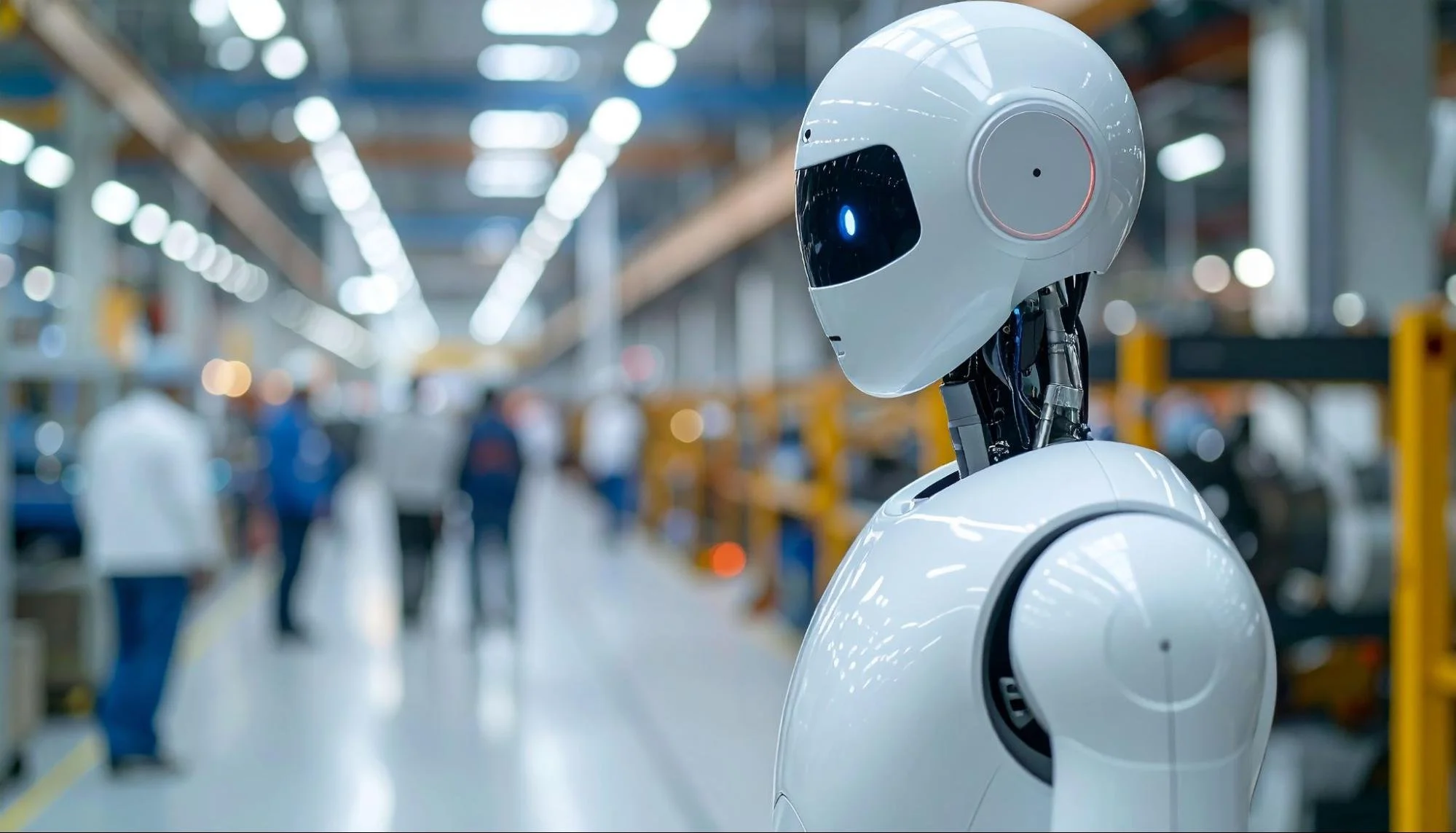
For decades, the humanoid robot existed only in science fiction — a compelling idea perpetually ten years away from reality. That era is over. In 2026, humanoid robots are assembling cars in BMW's factories, moving inventory in Amazon's fulfillment centers, and performing 16-hour shifts without complaint. What once seemed like fantasy has become an industrial inflection point, and the economic implications are profound.
From Lab to Factory Floor
The transition from prototype to production has been faster than almost anyone predicted. Several breakthroughs converged to make 2026 a pivotal year: manufacturing costs declined 40% year-over-year — far surpassing earlier projections of 15–20% annual reductions — AI-powered dexterity now enables robots to understand verbal instructions, adapt to novel situations, and handle irregular objects, and modern humanoid robots can operate 16–20 hour shifts before recharging, making them viable for two-shift factory and warehouse operations.
The result is a wave of commercial deployment. Tesla has deployed Optimus robots in its Fremont factory for material handling and assembly assistance. Figure AI's humanoid robots are working shifts at BMW's manufacturing facility in Spartanburg, South Carolina, handling warehouse logistics, parts sorting, and repetitive assembly tasks. Amazon has partnered with Agility Robotics, deploying Digit robots in its fulfillment centers for tote-moving and shelf-stocking operations.
Capital has followed conviction. The valuation of Figure AI jumped from $2.6 billion to $39 billion in just seven months, and mentions of 'humanoid' robots have risen 10x since 2020. Meanwhile, 21 new humanoid models were unveiled in 2025, signalling a wave of innovation across industries.
The Economics Are Becoming Irresistible
At the heart of the humanoid robot story is a cost curve that increasingly favors machines over humans or a wide range of physical tasks. At projected operating costs of just $2 per hour, humanoid robots present a compelling case — particularly for regions facing both labor scarcity and rising wage pressures.
The market opportunity is staggering. Given that labour compensation typically accounts for around 50% of a nation's GDP, the potential addressable market for humanoid robots could be as much as $50trillion, using a 2023 world GDP figure of $105 trillion. While full penetration of that figure remains a long-term scenario, the near-term trajectory is striking: Goldman Sachs Research projects the global humanoid robot market will reach $38 billion by 2035, a staggering sixfold increase from their earlier $6 billion estimate. In 2026 alone, industry analysts expect 50,000 to 100,000 humanoid robot shipments, with unit costs dropping rapidly toward the $15,000–$20,000 range as manufacturing scales.
Goldman Sachs analysis assumes productivity improvements, with humanoid robots working up to 20 hours a day by 2027 and achieving output efficiency equivalent to double that of a human worker. For CFOs evaluating capital allocation, those numbers produce payback periods that are increasingly difficult to ignore.
The Workforce Question
No conversation about humanoid robots is complete without confronting the most uncomfortable question: what happens to the workers they replace? The honest answer is: it depends — on the pace of deployment, the sector, and the policy responses governments choose to make. McKinsey Global Institute estimates that automation — including humanoid robots and AI — could displace between 400 and 800 million jobs worldwide by 2030, forcing up to 375 million workers (roughly 14% of the global workforce) to switch occupations entirely.
Jobs involving repetitive physical tasks in structured environments face the highest risk: assembly line workers, warehouse pickers and packers, machine operators, agricultural laborers, and fast food preparation workers are most exposed. Jobs requiring complex social interaction, creativity, strategic thinking, or work in highly unstructured environments remain safer.
Yet the picture is not entirely bleak. Many manufacturing facilities already struggle with chronic labor shortages. In the U.S., the National Association of Manufacturers reports over 600,000 unfilled manufacturing jobs as of 2025. Humanoid robots may initially fill vacancies rather than displace existing workers. In this framing, robots aren't taking jobs — they're filling gaps that a shrinking workforce can no longer cover.
Demographics: The Hidden Driver
Beneath the technology story lies a demographic reality that makes humanoid robots not merely attractive, but arguably necessary. Three demographic shifts are reshaping the global economy: aging populations are creating headwinds as the share of people aged 65 and above rises from 10% today to 16% by 2050, working-age cohorts are stagnating, and urbanization is concentrating talent in urban hubs while leaving sectors like manufacturing, agriculture, and elder care in rural areas short of labour.
By mid-century, the global population of people aged 60 years and older will double, topping 2.1 billion. Furthermore, the number of persons aged 80 years or older is expected to triple, reaching 426 million by 2050. For countries like Japan, already running at near-zero unemployment, humanoid robots in elder care settings aren't a disruption — they're a lifeline.Working-age populations are projected to decline sharply across key industrial regions by 2050, while workers are increasingly unwilling to accept harsh production environments. Humanoid robots, able to work dangerous, repetitive, or physically demanding jobs without fatigue or risk, address both problems simultaneously.
The New Jobs: Creation Alongside Disruption
Historical technology transitions have a consistent pattern: short-term displacement, long-term job creation. There is reason to believe humanoid robotics will follow the same arc, though the transition will be uneven. McKinsey's analysis indicates that historical technology transitions have consistently generated more jobs than they eliminated over the medium term, with 60% of today's U.S. workforce employed in occupations that simply did not exist in 1940. The robotics economy will generate demand for robotics engineers, robot maintenance technicians, AI training specialists, human-robot interaction designers, and safety auditors — roles that barely existed five years ago.
The critical variable is speed. The consensus among leading economists is that sustained mass unemployment from AI is unlikely, though temporary and painful disruption is not. Goldman Sachs models that each 1-percentage-point productivity gain from technology raises unemployment by approximately 0.3 percentage points in the short run, with this effect historically fading within two years. Whether governments invest adequately in retraining and education programs during this window will define how equitably the gains are distributed.
The Geopolitical Dimension
Humanoid robotics is also rapidly becoming a strategic competition between nations. China leads in production volume and is aggressively deploying state resources to dominate the supply chain for actuators, sensors, and the rare earth materials that power these machines. The U.S. is competing through private capital and innovation, while Europe navigates the tension between its ambitious industrial policy goals and stringent labor protections.
The global humanoid robot market is projected to grow from $2.92 billion in 2025 to $15.26 billion by 2030, registering a compound annual growth rate of 39.2%, with the U.S., China, and Europe leading deployment across manufacturing, healthcare, logistics, and retail. Which nations build and control the dominant platforms will have lasting implications for economic competitiveness, much as leadership in semiconductors or software defined the last half-century.
The Bottom Line
The humanoid robot is not a distant future — it is an emerging present. The cost curves are bending, the technology is maturing, and the demographic pressures are intensifying. For investors, the opportunity spans the entire stack: robot manufacturers, actuator and sensor suppliers, AI software platforms, and the facilities that will deploy these machines at scale.The global market for humanoid robots is poised to grow exponentially over the next several years, with some estimates of the total market size reaching $5 trillion over the next two decades. The companies that build, deploy, and service these machines — and the investors who back them early — stand to capture a disproportionate share of what may be the defining economic transformation of the coming generation.
The machines are rising. The question for every business leader, policymaker, and worker today is the same: are you ready?